
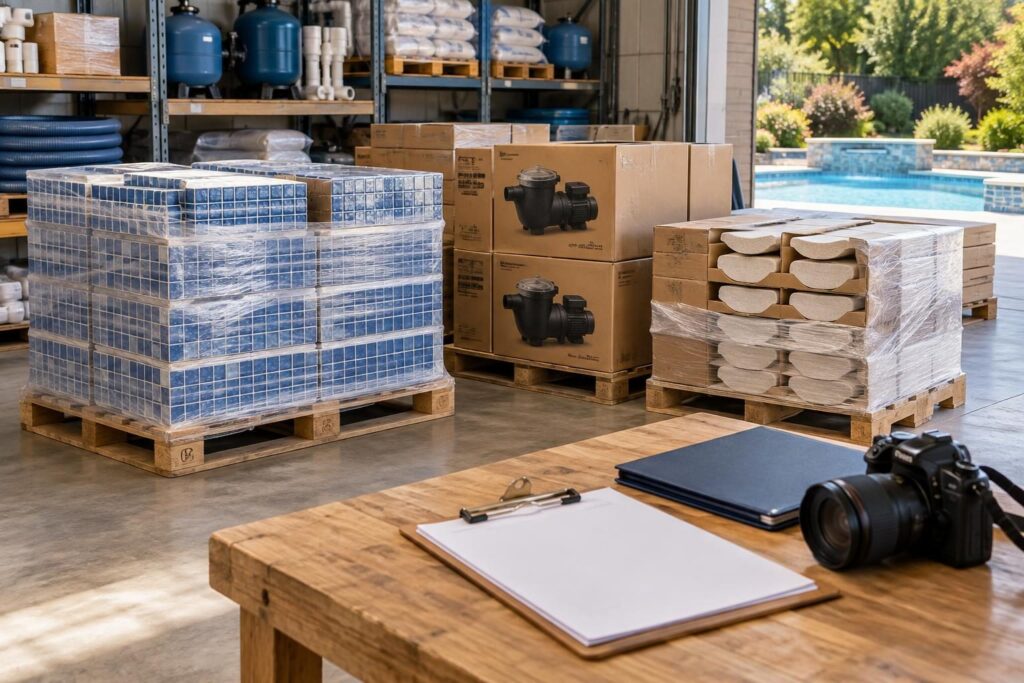
For North Carolina homeowners, pool offsite material payment verification starts with a simple question: what exactly does this invoice cover? A pump, heater, tile shipment, or coping order may be stored somewhere other than your property. Before approving payment, connect that charge to identifiable goods, a confirmed location, and written delivery arrangements.
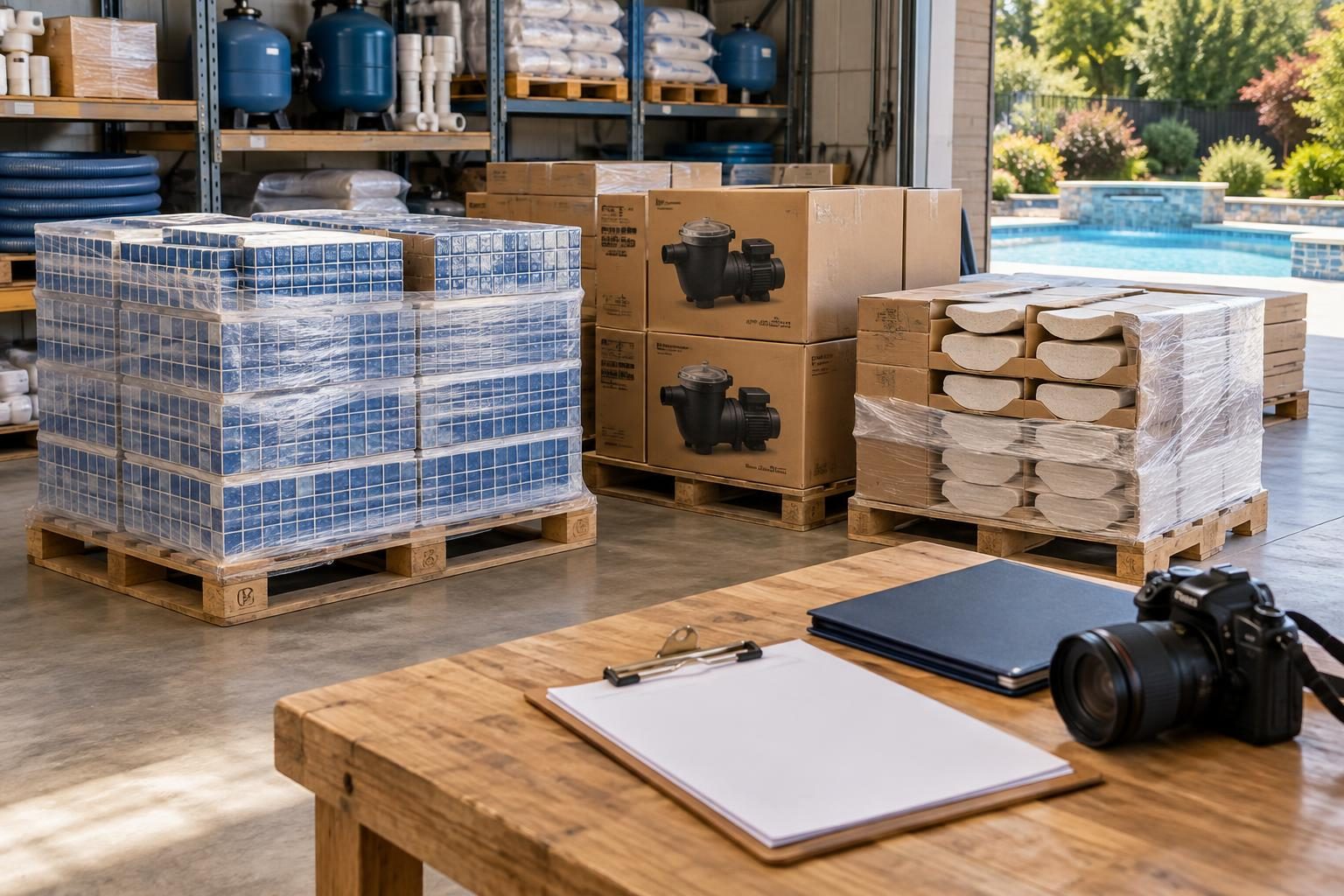
An invoice alone does not answer every question about availability, ownership, or damage responsibility. Request supporting records early enough to review them before the contractual payment deadline. Treat gaps as questions to resolve, not automatic evidence of wrongdoing.
Start with the contract’s stored-material payment terms
Find the payment milestone that supports the request. A milestone is a contract event that triggers a payment. Determine whether yours covers ordering, purchasing, storing, delivering, or installing materials. Those events are not interchangeable.
If the agreement only describes installed work, ask the contractor to explain the basis for an off-site material charge. Have any proposed change documented through the contract’s change-order process before approving it.
- Which contract line item does this invoice satisfy?
- Does the charge cover goods, freight, storage, handling, labor, or a combination?
- What supporting records does the agreement require?
- How will this payment appear as a credit on later invoices?
The North Carolina Licensing Board’s home-improvement contract guidance offers broader consumer context. For questions about payment obligations or changing terms, consult a North Carolina construction attorney. Do not assume this checklist changes your existing agreement.
Identify the pool materials behind each invoice
Useful pool offsite material payment verification connects the billed amount to specific products. Ask for an itemized schedule rather than a single entry labeled “pool equipment” or “materials.”
- Manufacturer, product name, model, and quantity.
- Serial numbers when available, or pallet, carton, and batch identifiers.
- Tile color, size, finish, and batch information where relevant.
- Supplier order number and contractor purchase-order reference.
- Your project reference and the amount billed against each item.
Compare these details with approved selections and specifications. If a listed model differs, request a written explanation and any required substitution approval. Do not let an invoice quietly replace an agreed product selection.
Request dated photographs showing labels and the surrounding stored shipment. Photos support identification, but they do not independently establish ownership, payment status, or exclusive allocation to your project.
Confirm the supplier’s records independently
Independent supplier confirmation is a key step in pool offsite material payment verification.
Ask the contractor to authorize supplier confirmation where needed. Use contact information you obtain independently, rather than relying solely on a forwarded message or invoice attachment. This helps confirm that the response comes from the actual supplier.
Ask whether the goods are physically available, merely ordered, backordered, or reserved from general inventory. “Ordered” does not answer whether the goods are ready for delivery.
- Does the supplier recognize the order and listed products?
- What quantities are currently on hand?
- Are specific goods allocated to this project?
- Has the supplier been paid, and what balance remains before release?
- Who may authorize pickup or delivery?
A supplier may limit account disclosures. Ask what project-specific confirmation it can provide with the contractor’s permission. Limited disclosure does not prove a problem, but unresolved availability or release questions deserve follow-up.
If document names differ, use a business-name verification process to clarify the supplier, contracting business, storage operator, and payment recipient.
Verify the storage location and project allocation
Request the storage address, facility operator, contact person, and date the goods arrived. Clarify whether storage occurs at a supplier warehouse, contractor facility, or another business’s premises.
Ask how staff distinguish your materials from stock available to other customers. Separate pallets, project labels, or inventory records can support tracking. None should be treated as a legal guarantee of ownership.
- Can the operator confirm the inventory and its current condition?
- Who controls access and approves removal?
- Can goods move to another location without written notice?
- Are storage charges current, and who pays future charges?
- How will updated records show partial withdrawals?
Ask the contractor to confirm compliance with product-specific storage instructions. Discuss weather exposure, moisture, security, and packaging protection. Arrange any visit through the facility operator; do not enter storage areas without permission or open protected packaging yourself.
Separate ownership questions from evidence of storage
A receipt, photograph, or project label can show different things. None should be assumed to establish your right to collect materials after payment.
Before paying, request written answers about when ownership transfers and what permits release. Ask what happens if the project stops, the contractor becomes unavailable, or the storage operator will not release the shipment.
These questions can involve contracts, supplier terms, and competing claims. Have a qualified North Carolina attorney review any proposed ownership, release, refund, or direct-payment arrangement. Ask whether additional documents are appropriate for your circumstances.
Do not redirect payment to a supplier without an agreed, reviewed process. Clarify how any direct payment would reduce your contract balance and prevent duplicate billing. Supplier confirmation helps establish facts; it does not replace legal advice about your rights.
Put damage and loss responsibility in writing
Ask who bears responsibility while goods remain in storage, during loading, in transit, and during unloading. Responsibility should not disappear between the warehouse door and your backyard.
- Who pays for theft, water damage, broken tile, or missing cartons?
- Who arranges replacement and any additional freight?
- Who documents damage and submits a claim?
- What happens to billing while replacement remains unresolved?
Request relevant insurance information, then ask a qualified insurance professional what coverage applies. A general insurance certificate should not be treated as confirmation that your specific goods and every transport stage are covered.
Confirm manufacturer warranty terms separately. Ask when coverage begins and whether storage conditions or delayed installation affect it. Retain the applicable warranty documents and written clarification rather than relying on a verbal assurance.
Connect stored materials to a workable delivery plan
Request a written delivery plan identifying the release contact, carrier, receiving person, and expected scheduling window. Distinguish a proposed window from a confirmed shipment appointment.
Clarify who pays loading, transport, unloading, and any repeat delivery charges. Ask who determines that the property is ready and what happens if the equipment pad or secure receiving area is unfinished.
Review truck access and unloading arrangements through your site-access protection records. Have the contractor coordinate safe access rather than improvising a route on delivery day.
North Carolina requirements vary by jurisdiction, adopted code, property conditions, utilities, septic systems, flood zones, and project scope. Verify site-readiness questions with local inspections staff and qualified professionals. A delivery plan does not establish that the installation location has required approvals.
Reconcile payment when the shipment arrives
Continue pool offsite material payment verification through delivery. Have the designated receiver compare arriving goods with the stored inventory schedule and delivery ticket. Record quantities, model numbers, visible condition, and missing items.
Photograph labels and visible damage from a safe location. Ask the responsible party to follow the carrier’s reporting process and confirm any applicable claim deadlines. Keep delivery acknowledgments separate from unresolved condition concerns.
Match delivered quantities to previous payments before reviewing the next invoice. A stored-material charge should remain traceable when later billing includes delivery or installation. Use your broader construction payment documentation checklist to reconcile the running balance.
Keep replacement records, corrected invoices, credits, and written resolutions together. Before materials or connections are covered, arrange safe progress photos with the contractor. Preserve required inspection and correction records separately; delivery documentation does not establish installation acceptance.
Make the approval decision from a complete record
A practical pool offsite material payment verification file should contain:
- The invoice and supporting contract provision or approved change.
- An itemized inventory matched to approved selections.
- Supplier confirmation and dated storage evidence.
- Written release, delivery, and damage-responsibility arrangements.
- Relevant professional advice and documented answers to unresolved questions.
- A payment ledger showing how later invoices will account for this charge.
Vague descriptions, inconsistent locations, unexplained substitutions, or pressure to approve without records warrant clarification. They do not automatically prove wrongdoing. Send a concise written request identifying each missing item, and preserve the response.
Consult a North Carolina attorney before changing payment arrangements or deciding whether to withhold a disputed payment. Ask an insurance professional about coverage and your licensed pool contractor about product handling. Use local inspections staff and qualified specialists for site-readiness questions. A complete file supports a better decision without promising legal or financial protection.