
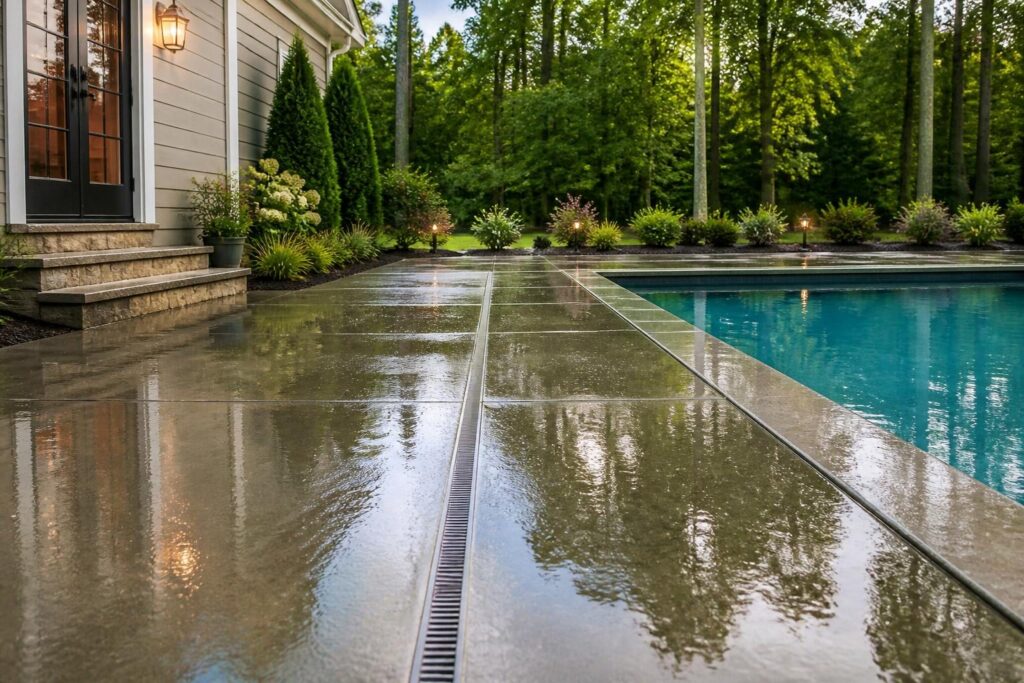
Pool deck surface drainage testing after installation helps a homeowner observe how rainwater behaves around a finished pool area. These checks involve visual, low-risk observations. They can reveal ponding, water moving toward doors, blocked channels, or low areas that deserve a contractor’s attention.

A visual check does not prove that a deck meets a plan, code, engineering design, or drainage standard. North Carolina conditions vary by jurisdiction, soil, slope, nearby structures, storm intensity, and the deck system used. Treat your observations as useful project records, not as a substitute for a qualified evaluation.
Why observe the deck after rain?
A dry deck can look complete while hiding how water moves during a storm. Rain creates a natural opportunity to watch the surface, joints, edges, channels, and nearby ground. The most useful observations occur during rain or soon afterward, while flow paths and wet areas remain visible.
Surface drainage means the way water travels across the deck toward an intended collection point or discharge area. A channel drain is a narrow, covered drain set into the surface. It collects water along a line. Other designs may use a sloped surface, area drain, trench, swale, or combination of features.
Review the approved plan, change records, and product information before drawing conclusions. If you do not have those documents, ask the project contact which drainage features the crew installed and where they should discharge. A related planning discussion appears in pool deck drainage around doors and walkways.
Prepare for a safe visual check
Do not walk onto a wet deck if lightning, flooding, slippery conditions, or poor visibility creates a hazard. Keep children and pets away from the area during the observation. Do not remove drain covers, enter channels, climb into excavations, or touch electrical equipment.
Use a phone or camera from a stable, dry location. Avoid standing near the pool edge to obtain a close image. A simple notebook can make the record more useful than a collection of unlabeled photographs.
Gather a small observation kit
- Phone or camera with the date and time visible in the file details.
- Notebook or digital note with weather and approximate rain duration.
- Copy of the site plan, deck plan, or drainage sketch, if available.
- Flashlight for viewing a channel opening from a safe, dry position.
- Basic location labels, such as “back door,” “pool steps,” or “equipment side.”
Do not use a hose to imitate a storm unless the contractor or designer recommends that method. A hose may not reproduce the volume, direction, or duration of natural rainfall. It can also move soil or water toward areas that were not meant to receive concentrated flow.
What to watch during and after rain
Begin with a wide view of the entire deck and adjacent yard. Then follow water visually without stepping into moving water. Look for the direction of flow, the time water remains, and whether a collection feature receives it.
Check for ponding and low areas
Ponding means water remains in a shallow area after surrounding surfaces have started to dry. Record where it appears and its approximate size using a familiar object for scale. Do not insert tools into a joint or drain to measure depth.
Photograph the area from the same direction each time. Note whether the water is near coping, a joint, a step, a seating area, or the edge of the deck. One isolated wet mark may reflect shade or a surface texture. A recurring pool in the same location provides more useful information for review.
Watch water near doors and walls
Observe whether runoff travels toward exterior doors, thresholds, garage openings, crawl-space access points, or foundation walls. Do not open a door into flowing water or allow water to enter the home while testing. Instead, record the approach path from a safe position.
Check nearby interior areas separately for signs of moisture, but do not remove finishes or investigate concealed spaces yourself. Water at a threshold can involve several parts of the building envelope. A qualified contractor or building professional can help determine what needs closer review.
Look at channels, inlets, and outlets
Watch whether water reaches a visible channel or drain inlet. Leaves, mulch, soil, and construction residue can obstruct an opening. Photograph the obstruction before moving anything.
Only remove loose surface debris if the feature supports routine homeowner cleaning and you can do the work safely from the surface. Never lift a heavy cover, reach into a narrow opening, or use a pressure tool to force material through a drain. Ask the installer about the intended cleaning method.
Follow the visible flow only as far as you can view it safely. Do not assume that a dry outlet means the system has a blockage. The discharge may run underground, route elsewhere, or release water slowly. Ask a qualified professional to evaluate concealed piping or unexpected discharge.
Document observations without overinterpreting them
Pool deck surface drainage testing after installation proves most useful when you repeat it under different weather conditions. A brief record can help separate a one-time storm response from a recurring pattern.
| Record | What to note |
|---|---|
| Weather | Date, approximate rain duration, wind, and whether rainfall was light or intense. |
| Location | Fixed landmarks near the wet area, channel, door, wall, or deck edge. |
| Flow | Direction of visible movement and whether water reaches a collection feature. |
| Timing | What remains wet during the observation and what changes later. |
| Condition | Leaves, soil, cracks, displaced sealant, edge washout, or visible surface changes. |
| Images | Wide view, close view, and the same angles on later dates. |
Use neutral descriptions. “Water remained beside the rear door after the surrounding deck looked dry” is stronger than “the deck was installed incorrectly.” Avoid assigning a cause based only on appearance.
Keep the record with your plans, invoices, product information, change documents, and completion notes. Construction photographs can add context, especially for features that later become concealed. You can review a related record-keeping approach in pool construction photo documentation by stage.
Patterns that merit follow-up
Several observations may justify a prompt conversation with the pool contractor or another qualified professional. These signs do not identify the cause by themselves.
- The same ponding area appears after more than one suitable rain event.
- Water repeatedly moves toward a door, wall, crawl-space opening, or other sensitive location.
- A channel or inlet receives little water while nearby surfaces send water toward it.
- Leaves, soil, or concrete residue repeatedly collect at the same opening.
- A low area seems to be growing, or its edge changes after rain.
- Runoff carries soil toward the deck, pool, property boundary, or neighboring improvements.
- Water discharges where you did not expect it, especially near foundations or walking areas.
Contact the project representative while the observation is fresh. Share labeled photographs, dates, weather notes, and the location on the plan. Ask what condition the drainage design expects and whether an on-site review is appropriate.
For broader construction runoff or disturbed-soil questions, consult the NC DEQ Construction Stormwater Program. Applicability can depend on the project and site. State information does not replace local direction or a site-specific assessment.
Questions to ask before requesting a review
Clear questions help keep the conversation focused on observable conditions. Consider asking:
- Which surface areas should drain to each channel, inlet, or edge?
- Where should collected water go after it leaves the deck?
- Does routine cleaning apply, and which cleaning method does the installer approve?
- Could nearby landscaping, irrigation, mulch, or roof runoff change the observed flow?
- Should the deck receive a review during a particular type of rain?
- Which professional should assess a concern involving the foundation, grading, or concealed drainage?
- What records should you add to the project handover file?
Do not make repairs, cut concrete, alter a channel, add soil, or redirect discharge before documenting the condition and asking who should evaluate it. An unapproved change may hide the original pattern or affect other parts of the site.
Use observations as an ongoing maintenance record
Pool deck surface drainage testing after installation should not end with the first storm. Seasonal changes can affect runoff. North Carolina yards may experience intense rain, falling leaves, freeze events, shifting soil, irrigation changes, and new landscaping.
A fourth observation round can extend pool deck surface drainage testing after installation after major landscaping work or an unusually strong storm. Compare images from the same locations. Also watch whether soil, mulch, or plant growth begins to cover a collection point.
Keep drainage observations separate from pool water-care records. Water on the deck concerns surface flow and site conditions. Pool chemistry, circulation, and equipment require different records and qualified service when problems exceed routine maintenance.
When professional evaluation is the right next step
Homeowner observations can identify patterns, but they cannot confirm slope, structural performance, underground routing, code compliance, or the cause of moisture. Stop and seek help if water enters the home, erosion is active, a surface becomes unsafe, or electrical equipment sits in water.
Ask the local inspections department about current jurisdictional requirements when a permit, inspection, grading change, or drainage discharge is involved. A licensed pool contractor can review installed features. An engineer, surveyor, drainage specialist, electrician, building professional, or other qualified specialist may suit a condition outside routine observation. Build a Pool in North Carolina offers homeowner-focused planning information, but local authorities and qualified professionals must guide site-specific decisions.