
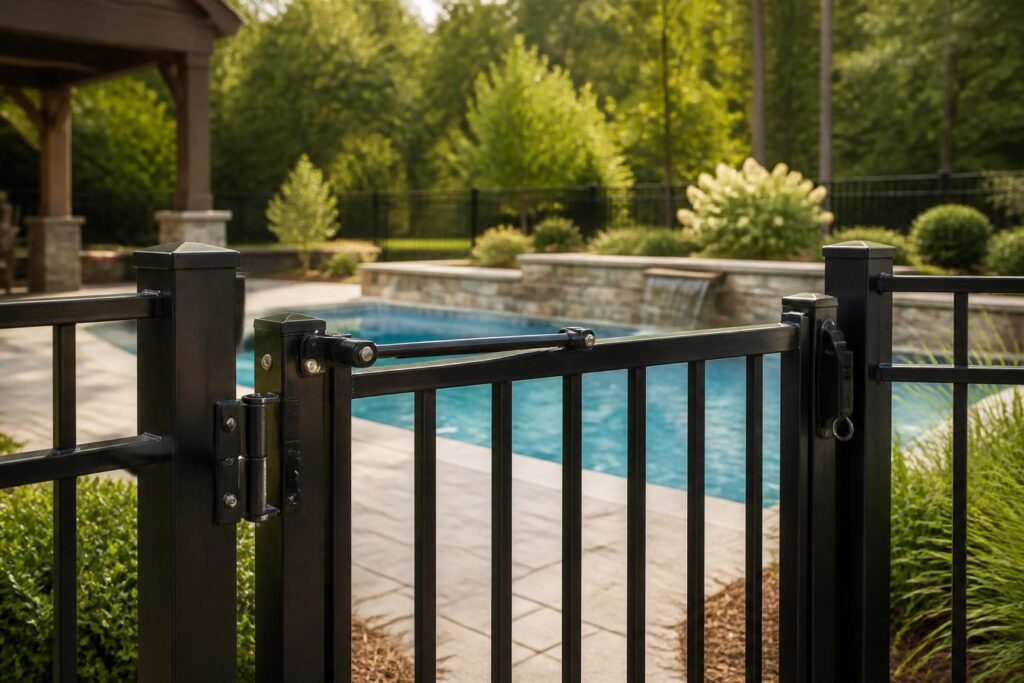
Pool gate self closing adjustment questions can help North Carolina homeowners notice small changes before a barrier becomes unreliable. A gate may look secure while rubbing, slowing, failing to latch, or shifting after landscaping, weather, or normal use.

This guide focuses on observation and documentation. These pool gate self closing adjustment questions do not replace a local inspection, adopted code, manufacturer instructions, or qualified repair work. Requirements can vary by jurisdiction, property conditions, adopted code, and the design of the pool barrier.
Start with the gate’s basic closing movement
Watch the gate from several positions. Open it normally, then release it without pushing or pulling. Observe whether it returns toward the closed position and whether the movement changes near the latch.
A self-closing gate uses hinges, springs, hydraulic hardware, or another closing mechanism. The hardware should operate as a complete system. Do not assume that tightening one visible screw will correct every problem.
- Can the gate swing freely without scraping the post, deck, latch, or ground?
- Will it close from different starting points, or only when opened slightly?
- Does the gate slow sharply before reaching the latch?
- Could wind, a slope, or nearby furniture interfere with its movement?
- After movement stops, does the gate remain in the closed position?
Repeat the observation after ordinary use. A gate that closes once may behave differently after several cycles. Record the date, weather conditions, gate position, and result. Short videos can show movement more clearly than a written description, but avoid recording children as part of a safety test.
Pool gate alignment: look for changes at the opening
Alignment describes how the gate sits in relation to its posts, hinges, latch, and surrounding barrier. A small shift can create rubbing or change the point where the latch meets its receiver.
Stand on the approach side and look at the gaps around the gate. Then view it from the hinge side. You are looking for changes, not trying to establish a legal measurement.
- Are the top and bottom gaps visually consistent with the gate’s previous condition?
- Does one corner sit lower than it did during installation?
- Are hinge fasteners, posts, or brackets visibly loose?
- Has soil, mulch, concrete movement, or landscaping changed the gate’s clearance?
- Does the gate contact the ground or deck during part of its swing?
North Carolina yards can experience wet weather, seasonal soil movement, settling, and landscape changes. A new planting bed or added soil can also affect access around a barrier. For related observations after yard work, see how landscaping changes can affect a pool fence inspection.
Do not force a sagging gate into alignment. Take photos from repeatable locations and ask the installer, hardware manufacturer, or qualified pool professional to evaluate the cause.
Pool gate latch engagement deserves careful attention
The latch is the part that holds the gate closed. Engagement means the latch component enters and remains secured in its receiving hardware. A gate can appear closed without being latched.
Listen for the latch to meet its receiver, but do not rely on sound alone. From a safe position, observe whether the latch fully engages after the gate closes. Avoid pulling hard on the gate, defeating the latch, or testing it while anyone is near the opening.
- Will the latch engage consistently from the gate’s normal release point?
- Must the gate receive a push, lift, or repeated movement before it catches?
- Could contact with the receiver prevent full engagement?
- Are covers, guards, caps, or fasteners cracked, missing, or loose?
- Can an adult operate the latch smoothly when releasing it?
Keep the latch area clear of toys, cords, planters, decorations, and temporary hardware. Those items can obstruct movement or create a reason for someone to prop the gate open.
The CPSC residential pool barrier guidelines provide consumer-safety information about barriers and gates. They are not a substitute for the requirements enforced in your jurisdiction. Confirm current rules with your local inspections department.
Observe closing speed without trying to tune it yourself
Closing speed can change as hinges wear, springs lose tension, hydraulic devices age, or the gate becomes misaligned. Temperature and weather may also affect some hardware. The goal is to notice a meaningful change.
Compare the gate with an earlier video or maintenance note. Look for a gate that pauses, slams, rebounds, or stops short. A very fast closing motion can damage hardware or create a pinch hazard. A very slow motion may leave the opening unsecured for longer.
Questions about closing speed
- Has the closing speed changed since installation or the last service visit?
- From both directions, does the gate close at the same rate?
- In cold, wet, or windy conditions, does its behavior change?
- After contacting the latch hardware, does the gate bounce back?
- Does the closing device show oil, cracks, corrosion, or physical damage?
Some devices include adjustment screws or valves. Their location and adjustment method depend on the product. Follow the manufacturer’s instructions or use a qualified professional. Avoid making repeated changes without recording the original setting, because undocumented adjustments can make later troubleshooting harder.
When reviewing pool gate self closing adjustment questions, focus on repeatable observations rather than a single successful cycle. A consistent record gives a professional better information than an unverified adjustment.
Watch for wear, corrosion, and repeated-use problems
Pool gates operate outdoors and may face moisture, fertilizer, salt, cleaning chemicals, insects, and frequent use. Surface corrosion does not always mean the hardware has failed, but it deserves attention when it affects movement or fastening.
Inspect visible components during routine pool-area checks. Use a flashlight for shaded hinge areas. Do not remove protective covers or disassemble closing hardware unless the manufacturer’s instructions specifically allow that task for a homeowner.
- Hinges: look for binding, unusual noise, movement, or visible damage.
- Fasteners: look for looseness, missing pieces, rust, or stripped heads.
- Latch parts: look for worn contact surfaces, cracks, and poor engagement.
- Posts and connections: look for movement, leaning, or separation from adjacent work.
- Gate frame: look for bending, sharp damage, or a changed shape.
Never lubricate a component automatically. Some products require a specific lubricant, while others may collect grit or affect the mechanism. Ask the hardware manufacturer or a qualified service professional what maintenance is appropriate.
A broader review can help you organize observations. Use this pool barrier gate hardware inspection checklist alongside the gate’s product instructions and your local requirements.
Keep a simple gate adjustment and observation record
Good records help separate a one-time event from a recurring issue. They also give a qualified professional useful information without asking you to diagnose the hardware.
| Record | What to note |
|---|---|
| Date and conditions | Rain, wind, temperature changes, landscaping work, or unusual use |
| Alignment | Rubbing, sagging, changed gaps, or contact with the ground |
| Closing action | Release point, pauses, rebound, slamming, or failure to close |
| Latch | Whether it engaged without pushing, lifting, or repeating the cycle |
| Wear | Corrosion, cracks, loose fasteners, noise, or visible damage |
| Follow-up | Photos, videos, product information, service notes, and next steps |
Save the gate model, hardware instructions, installation records, repair invoices, and photos of the original installation. If a gate or barrier changes during a pool project, retain approved plans and inspection documents with the rest of your home records. This guide to North Carolina pool permit and inspection records explains why those documents matter after approval.
Your pool gate self closing adjustment questions record can also note who evaluated the hardware, what instructions they provided, and which follow-up date was suggested. Keep observations separate from conclusions about compliance.
Know when to pause use and request help
Treat a gate as a safety system, not just an outdoor door. If it fails to close, does not latch, has a loose post, or shows damaged hardware, keep the pool area inaccessible until a qualified person evaluates the condition. Do not rely on supervision alone as a substitute for a functioning barrier.
Do not allow anyone to prop the gate open during gatherings. Tell household members and guests to report changes rather than attempting improvised repairs. A temporary control may be appropriate only when it genuinely prevents access and does not create a new hazard; ask a qualified professional what is suitable for your property.
Requirements for residential pool barriers, gates, setbacks, permits, and inspections can differ across North Carolina jurisdictions. Local adoption, property layout, barrier design, and project scope may change what applies. Contact the local inspections department for current requirements before altering a barrier.
Consult a licensed pool contractor or gate-hardware professional for mechanical evaluation and adjustment. If the gate connects to electrical access control, consult a licensed electrician. For questions involving a deck, retaining wall, settlement, or structural movement, ask an appropriately qualified professional. Build a Pool in North Carolina offers homeowner education, but local authorities and qualified specialists must address site-specific decisions.